
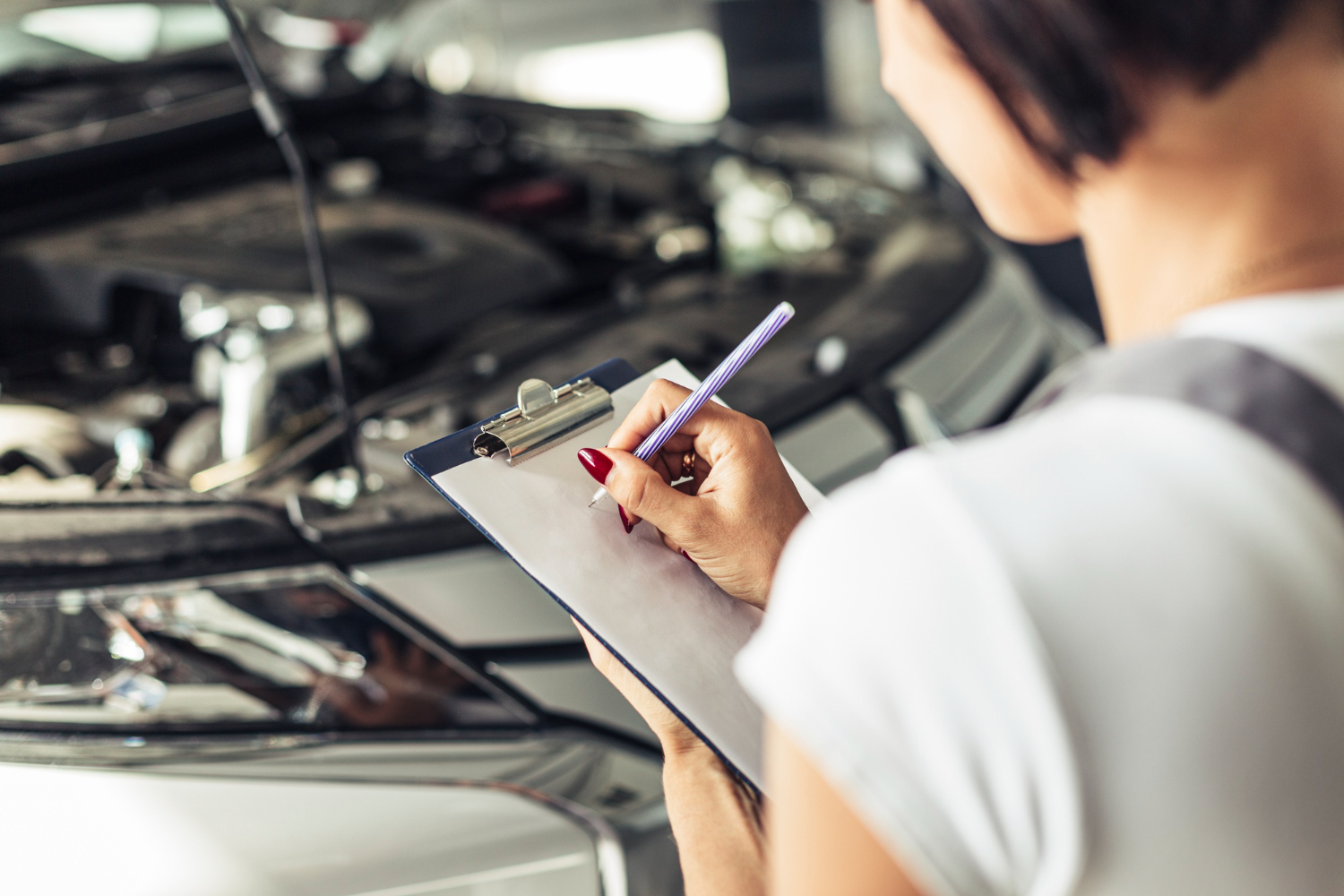
What Shops Check Before You Buy a Used Car
Before wiring $18,000 to a stranger off Marketplace, spend $150 and an hour at a shop first. That’s the cheapest insurance you’ll ever buy on a used car.
A pre-purchase inspection, or PPI, runs $100 to $200 at most independent shops as of 2026, and a thorough one takes about an hour. For that price you get a straight answer on whether the car is solid or a problem waiting on you. Here’s what that hour actually covers.
Frame and Structure
A tech starts underneath the car, not under the hood. That means a tap test along the frame rails and a look at the spots known to rust or crack on that particular make and model, like the rear frame rails on an aging Jeep Grand Cherokee.
Bolt-on crossmembers and mounting points get a look too, along with any spot where rust has gone from surface flaking to actual perforation. Surface rust on an older car in a salt-belt state is normal. Rust you can push a screwdriver through is not.
A paint thickness gauge comes out too. Heavy paint in one spot on a fender or door usually means bodywork, and bodywork nobody mentioned in the listing is worth asking about.
OBD Scan With Live Data
Plugging in a scanner and pulling codes is step one, and it only takes a few minutes. Any shop can do that, and so can an app on your phone.
The real value shows up in live data. A tech watches fuel trims, the misfire counter, and temperature behavior while the engine actually runs. That’s the kind of auto diagnostics work that catches a problem building before it ever trips a check engine light.
A cylinder that’s starting to misfire under load, or fuel trims already running rich or lean, won’t show up on a basic code pull. A clean code read alone won’t show you that.
This is also where a shop checks for a mismatched VIN between the dashboard, the door jamb sticker, and the title. It’s not common, but it takes thirty seconds to rule out and it matters more than almost anything else on this list.
Leak Inspection
The car goes up on a lift and gets checked for leaks everywhere it counts: engine, transmission, differential, power steering, and coolant.
A little weep on an old gasket isn’t a dealbreaker by itself. A transmission that’s actively dripping fluid on a car with 60,000 miles on it is a different story. That’s exactly the kind of thing a test drive around the block won’t tell you.
Fluid condition matters as much as whether it’s leaking. Transmission fluid that smells burnt, or coolant that looks rusty instead of clean, points to a system that hasn’t been maintained even if nothing’s dripping onto the driveway yet.
Brake Pad Measurement
This part is simple and it should never get skipped. A tech measures actual brake pad thickness in millimeters instead of eyeballing it through the wheel, and checks rotor thickness against factory spec.
Worn pads aren’t a big deal on their own. They’re a normal wear item and a $150 to $300 fix. Warped or undersized rotors on top of that push the job closer to $400 to $700, and that’s worth knowing before you sit down to negotiate.
Brake fluid gets a look too. Fluid that’s gone dark and hasn’t been flushed in years is a sign of deferred maintenance that probably extends past the brakes.
Suspension Play
The car gets lifted so a tech can grab each wheel and check for play in the ball joints, tie rods, and bushings. Loose suspension parts mean money down the road, and sometimes a safety issue sooner than that.
Shocks and struts get a bounce test and a visual check for fluid weeping down the housing. A car that bounces twice after you push down on a corner is running on tired shocks, even if it still rides fine on a smooth road.
This is also where a shop catches the “drives fine” used car that’s actually got play a 20 mph test drive around the block will never reveal.
Tire Age
Tread depth is the easy part. Tire age is the part people miss, and it’s read off the DOT code stamped on the sidewall.
A tire can look fine and still be six or seven years old. Rubber breaks down over time no matter how much tread is left. A tire over six years old is one to plan on replacing soon, regardless of what the tread gauge says.
The spare gets checked too, along with whether it’s a real spare or one of the space-saver kind that’s only good to get you to a shop. A lot of buyers never look until they need it, which is exactly the wrong time to find out it’s flat or missing.
Accident Signs
Beyond the paint gauge, a tech checks panel gaps, overspray in the wheel wells or door jambs, and any parts that look newer than the rest of the car.
Mismatched paint on one door is worth a question. Four doors that don’t line up the same way down the side of the car is worth walking away from.
An airbag warning light that’s been in the dash for weeks, or a steering wheel that sits slightly off-center, are both quiet signs of a prior accident that a listing photo won’t show.
None of this replaces a vehicle history report. A PPI checks the actual metal in front of the tech. A history report checks the paperwork trail. Get both, since they catch different things and neither one covers for the other.
The Bottom Line
None of this means every used car with a repair history is junk. It means you should know what you’re buying before you buy it, not after.
A quick “looks good” from the seller’s mechanic isn’t a PPI, even when it sounds close enough. Get the inspection done somewhere with no stake in the sale, get it in writing, and use it to negotiate or walk.
For everything else a shop can look at beyond the PPI itself, the car repair page covers the full range of services. The About the shop page covers who’s doing the inspecting.
FAQ
How much does a pre-purchase inspection cost? Most independent shops charge $100 to $200 for a standard PPI, depending on the vehicle and how thorough the inspection is.
How long does a pre-purchase inspection take? About an hour for a full inspection covering the frame, the mechanical systems, and a live-data scan.
Can I get a pre-purchase inspection on any used car? Yes. Any shop with a lift can do one, though it’s smart to schedule ahead since private sellers don’t always want to wait around.
What if the seller already had a mechanic look at it? That’s not the same as an independent PPI. A mechanic picked by the seller has no reason to flag problems that could kill the sale.
Is a pre-purchase inspection worth it on a cheap car? Yes, maybe more so. A $150 inspection on a $6,000 car can still catch a $2,000 transmission problem before it becomes yours.