
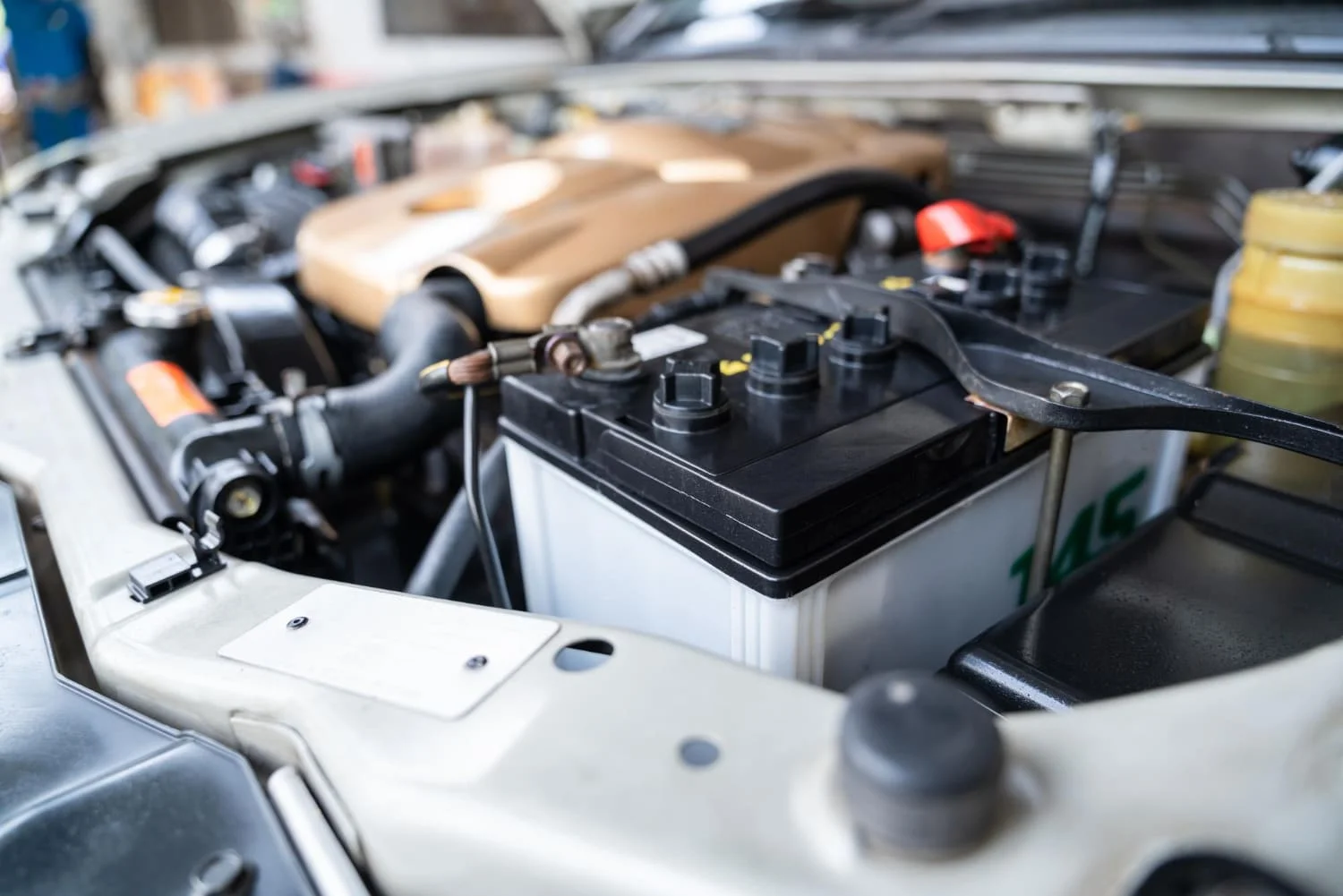
Car Battery Warning Signs
That first real cold morning of the year is when weak batteries give themselves away. A battery that limped through October will leave you stuck in a parking lot in November.
As of 2026, most car batteries last 3 to 5 years, and anything past 5 is borrowed time. The usual warning signs are a slow crank on cold mornings, headlights that dim at idle, random electrical glitches, and crusty terminals. Replacement runs $200 to $400 installed. Catching it early is the cheap way to do it.
Slow Crank on Cold Mornings
Every battery cranks a little slower when it’s cold. That’s normal. What’s not normal is a crank that sounds labored, like the engine is dragging its feet, or one that gets a little worse each week.
A healthy battery turns the engine over briskly even at 20 degrees. A worn-out one gives you a slow “rur… rur… rur” and sometimes just a click. If the starter sounds like it’s struggling on a morning that isn’t brutally cold, the battery is usually the first suspect, not the starter.
Dim Headlights at Idle
Sit in the driveway at night with the engine idling and watch the headlights. If they look dim, then brighten when someone revs the engine, the electrical system is struggling to keep up.
Most people blame the alternator here. Sometimes that’s right. But a battery that can’t hold a charge makes the alternator work harder than it should, and the lights show it. Either way, it’s worth a test before the problem picks a bad moment to get worse.
Electrical Weirdness
Radio presets that reset. Dash lights that flicker when you start the car. Power windows that crawl up slower than they used to. A clock that keeps losing the time.
These all point to voltage dropping under load. Modern vehicles are packed with modules that get cranky when voltage sags, and the symptoms can look like a dozen unrelated problems. Plenty of people chase a “bad radio” for weeks when the battery was the real culprit.
Corrosion on the Terminals
White or green crust on the battery terminals isn’t always a dead battery. Sometimes it’s just a cleanable connection problem, and a wire brush and some terminal protectant fix it for a few bucks.
But heavy corrosion on an older battery is a flag. Check the date on the case. If it’s past the 4 or 5 year mark, don’t just scrub the terminals and call it good.
Age Counts More Than You’d Think
Short trips, summer heat, and a lot of accessories all shorten battery life. Vehicles with auto start-stop, like many newer Ford F-150 trucks, lean on AGM batteries and tend to wear them faster. Those premium AGM units sit at the higher end of the $200 to $400 range.
A battery that’s 5 to 7 years old can still crank today and strand you tomorrow. There’s no gradual warning on some of them. They just quit.
What a Real Battery Test Looks Like
A proper test isn’t just checking whether the battery shows 12.6 volts. Surface voltage can look fine on a battery that falls apart the moment it’s asked to do real work.
A shop uses a load test, a voltage drop test, and a conductance test, which measures the battery’s internal condition. That’s the kind of testing that comes with proper auto diagnostics. The free test at an auto parts store is a decent first check, but it can miss a dying battery, especially if the battery isn’t fully charged when it’s tested or if the test only reads conductance.
If the battery passes everything, the next step is the charging system. An alternator that’s undercharging will kill a good battery over time, so the two get tested together.
What to Do This Week
Spotted one or two of these signs? Don’t wait for a second cold snap. Get the battery load tested while the car still starts, because a test on a battery that’s already dead only tells you what you know.
A battery that tests weak gets replaced. One that tests fine but still acts up points to the charging system or a wiring problem, and that’s where electrical and starter diagnostics earn their money. Guessing at parts is how a $300 problem turns into $700.
Do It on Your Schedule
Replacing a battery on your own schedule is about $300 and a Saturday morning. Replacing it on the battery’s schedule is a tow truck, a missed shift, and the same $300 anyway.
FAQ
How do you know if your battery is dying?
The big signs are a slow crank, dim headlights at idle, electrical glitches, and age past 3 to 5 years. A load test or conductance test confirms it.
How long does a car battery last?
Most last 3 to 5 years. Some reach 6 or 7 with gentle use, but heat, short trips, and heavy electronics shorten that.
How much does a new car battery cost?
As of 2026, expect $200 to $400 installed. AGM batteries for vehicles with start-stop systems run toward the high end.
Can a battery test good and still fail?
Yes. A quick surface-voltage check can miss a weak battery. A load test shows how it performs under real demand.