
You Can Do Some of This Yourself, and Some of It Will Cost You Double
It’s 11pm, a repair video is playing, and the thought shows up: that looks easy enough to do yourself. Sometimes it is. Sometimes $200 in tools and four hours of garage time lands you at break-even with the shop, with a worse result.
As of 2026, the clear DIY jobs are air filters, cabin filters, wipers and a battery swap. Brake pads are doable with a torque wrench and the right setup. Timing belts, AC work and anything needing electronic calibration belong at a shop. Here’s the breakdown, tier by tier.
Tier 1: Do These Yourself
Air Filter and Cabin Filter
Parts run $15 to $40 each. Most take five minutes and a screwdriver, and some need no tools at all. A shop charges more in labor than the part costs, so this one’s a no-brainer.
Wipers
$20 to $50 for a pair. Match the length listed for your make and model, click them on, done. The only way to mess this up is buying the wrong size.
Battery
A new battery runs about $150 to $350 depending on the vehicle. Most auto parts stores will install it free if you buy it there, which makes paying a shop for the swap hard to justify. One catch on newer cars: some need the battery registered with the computer after the swap, so check before you start on a late-model European or a vehicle with start-stop.
Oil Change, If You Have Ramps
This one earns its spot only with the right setup. You need ramps or jack stands, a drain pan, a filter wrench and a way to get the old oil to a recycler. Add it up and the tools cost $100 or more before the first job.
Do the math on how many oil changes you’ll actually do. If the answer is two or three a year, the savings per change are small and the mess is real. If you run several vehicles or like the routine, it pays off.
Tier 2: Doable, With Caveats
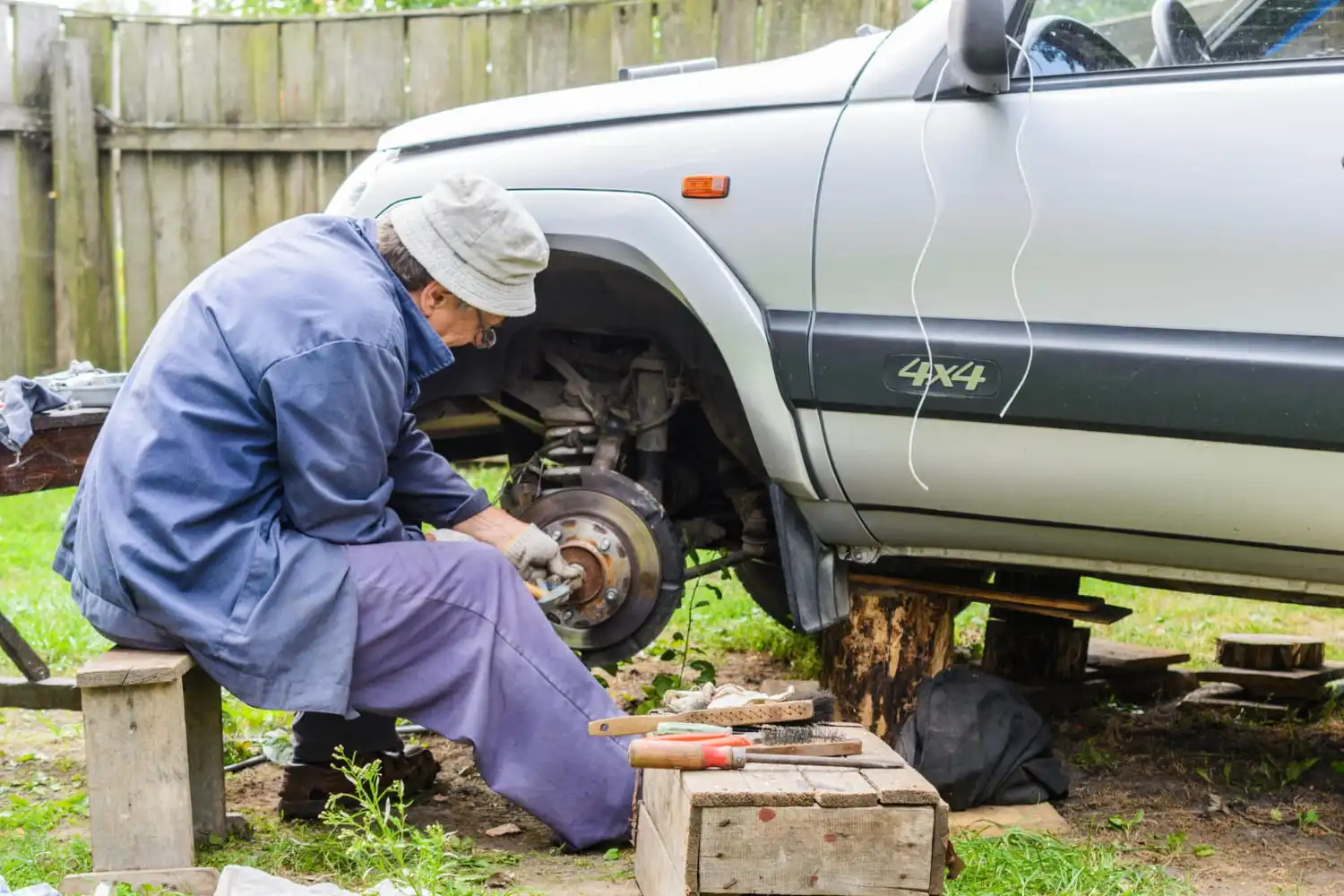
Brake Pads
Pad swaps on most vehicles are a legitimate home job. You’ll want a quality torque wrench, a caliper compression tool, brake cleaner, hardware lubricant and a set of jack stands. Not a floor jack alone. Ever.
What goes wrong is the little stuff. Caliper slide pins that aren’t cleaned and greased cause uneven wear and noise. Lug nuts and caliper bolts tightened by feel instead of to spec cause bigger problems. And a seized caliper or rusted-out rotors turn a $150 to $300 pad job into a $400 to $700 pads-and-rotors job, or a $300 to $600 per side caliper replacement. That’s when a professional brake repair beats the driveway.
Pads touch the one system that has to work every time. If something looks off, like a stuck bolt, leaking fluid or a spongy pedal, stop and hand it over.
Spark Plugs
This one swings wildly by engine. A base four-cylinder with plugs sitting right on top of the valve cover is a 30-minute job. A Ford 5.4L 3V Triton in an F-150 from 2004 to 2010 is a different animal. Those two-piece plugs are known to seize and snap, and extraction pushes the bill from $300 to $500 up to $800 to $1,500 or more.
Check your specific engine before you buy a single plug. NGK, Denso and Motorcraft are the usual quality brands, and cheap plugs cost you twice.
Serpentine Belt
Fine if you can release the tensioner. Many cars use a standard breaker bar on a square drive. Some need a thin, special tool to reach it. Take a photo of the belt routing before you pull the old one, because getting it back on wrong is the classic mistake.
Parts run $25 to $60, and a shop typically charges $100 to $200 total.
Tier 3: Skip It and Call a Shop
Alignment
There’s no home version of a proper alignment. It takes a machine that measures toe, camber and caster to fractions of a degree. A four-wheel alignment runs roughly $150 to $200, and it protects a set of tires that costs a lot more than that.
AC System Work
A can of refrigerant from the parts store can’t find the leak, and it can overcharge the system if the gauge reads wrong. Proper service means recovering the old refrigerant and running a leak check, which usually runs $150 to $250 for a recharge with leak check. Compressor jobs run $600 to $1,500. Venting refrigerant isn’t an option, and it’s not legal either.
Timing Belts and Timing Chains
One tooth off and the engine can run rough, or on an interference engine, bend valves and wreck itself. The job takes specialty tools, service data and zero room for error. This is the clearest case on the list where a $1,000 job done right beats a $4,000 engine done wrong.
Anything Needing Electronic Calibration
Most modern repairs now do. Replace a part that talks to a computer and the computer often has to be told about it. That covers things like ADAS cameras and sensors after a windshield swap, throttle bodies, steering angle sensors and many electronic components.
A basic code reader will tell you what’s wrong. It won’t do the relearn.
When the Shop Is Actually Cheaper
Count the real cost of a DIY job, not just the parts. Tools, your time, a second trip for the part you forgot, and the price of a mistake all add up. A first-time brake job with $200 in new tools often costs more than the shop would have charged. The second and third time, the math flips.
The honest rule: if the job is cheap to redo and low-risk if it goes wrong, do it. If a mistake can hurt you, hurt the engine or void a safety system, pay for car repair done right.
The Tier List, Saved
Do yourself: air filter, cabin filter, wipers, battery, and an oil change if you have ramps and a plan for the old oil. Do with care: brake pads, spark plugs (check your engine first) and a serpentine belt, but only with the right tools and a willingness to stop and call a shop when something doesn’t look right. Skip: alignments, AC work, timing belts and chains, and anything that needs a computer to relearn a part. Save a few hundred dollars where it’s easy, and spend a few hundred where it’s not.