
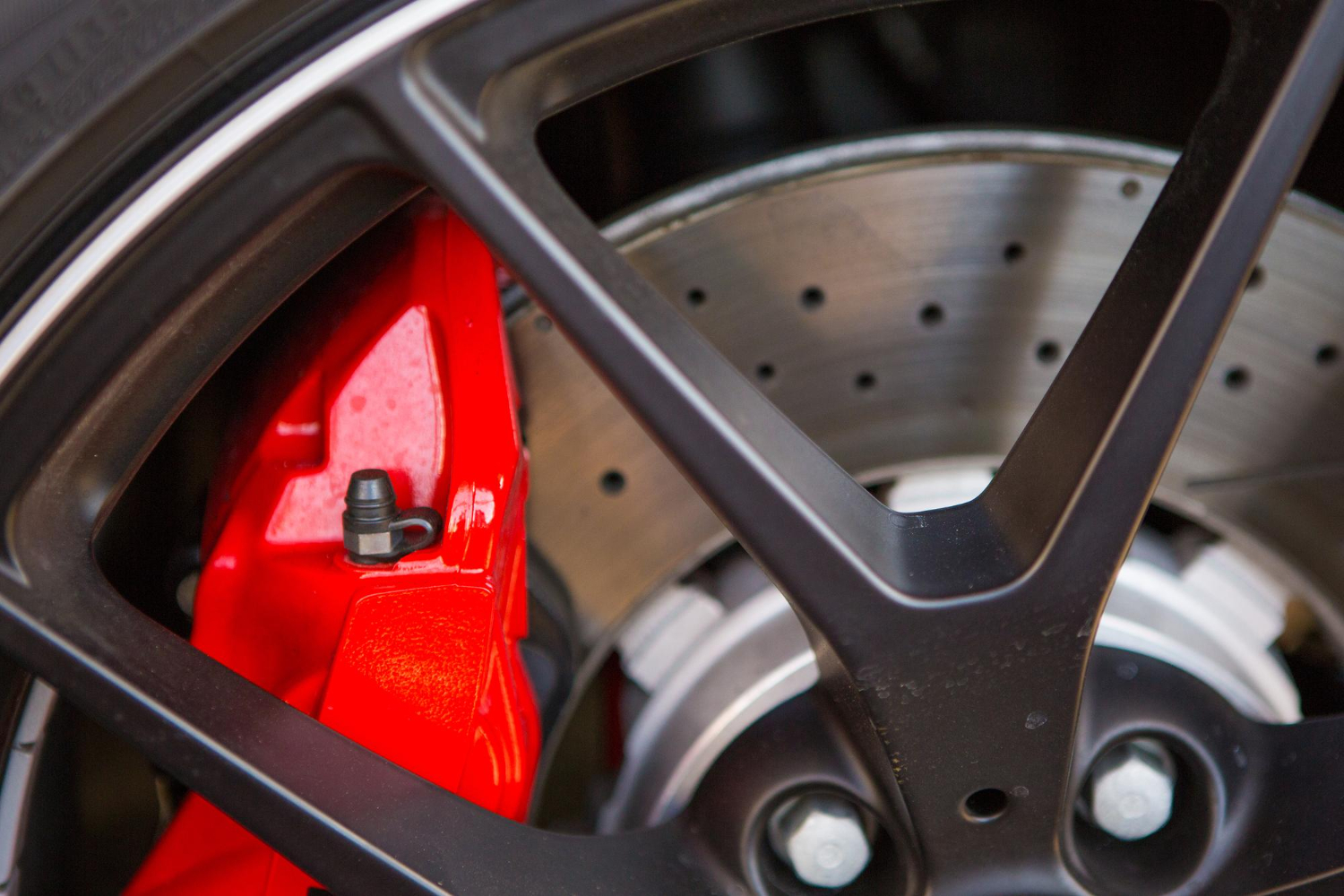
Noisy Brakes? Here’s Why
That cold-morning squeal when you back out of the driveway? The one that fades after a couple stops? Most drivers tune it out for weeks. Sometimes months. By the time the noise gets bad enough to take seriously, the cheap fix is usually gone.
Most brake noise comes down to three things: worn-out pads hitting the wear indicator, a stuck caliper, or rotors that are glazed or warped. As of 2026, brake pads alone run $150 to $300. Pads plus rotors land closer to $400 to $700. A seized caliper bumps the bill to $300 to $600 per side, and worst case, you’re looking at $800 to $1,200 or more. The longer you wait, the worse the math gets.
Which noise you’re hearing tells you which one you’ve got. Here’s how to read it.
The Squeal
A high-pitched squeal when you brake is usually the wear indicator doing its job. That’s a little metal tab built into the pad that scrapes the rotor on purpose once the friction material gets thin. It’s there to make noise. The noise is the warning.
Catch it early and you’re in pad territory: $150 to $300 depending on the vehicle and the pad you go with. A Honda Civic sits on the cheaper end. A F-150 with bigger calipers and heavier rotors lands higher.
Cold-morning squeal that goes away after the brakes warm up is a different animal. That’s usually surface rust on the rotor face from sitting overnight in damp weather. Drive normally, hit the brakes a few times, and the rust scrubs off. Not a problem. Just don’t confuse that with a real squeal that sticks around through the whole drive.
Cheap pads squeal too. Bargain-bin organic pads or no-name ceramics will sing on you in cold weather or after a hard stop. Name-brand pads from Akebono, Wagner, Bosch, or Power Stop run quieter and last longer. Cheap parts cost you twice.
The Grind
Grinding is metal on metal. The pad material is gone and the backing plate is dragging on the rotor. This is the one nobody should sit on.
Grinding means the rotor face is getting cut every time you stop. Once the rotor is gouged past spec, you can’t just slap new pads on and call it done. Now it’s pads and rotors, and that $150 pad job turns into $400 to $700.
Let it grind long enough and the caliper takes damage too. The piston extends past its normal travel, the seal goes, and you’re swapping a caliper at $300 to $600 a side. On a four-wheel disc setup with cooked rotors and a couple of toast calipers, you’re at $800 to $1,200 plus.
Grinding is the noise that turns a $300 job into an $800 one in about two weeks of driving. Don’t ride it out. Get your brakes inspected.
The Clunk When You Stop
A clunk or thunk right as you come to a stop, or right when you let off the brake, usually isn’t the pads themselves. Most of the time it’s suspension or steering parts loading up under the weight shift. In that case, a suspension inspection may be in order.
Worn sway bar end links, a tired ball joint, or a shot control arm bushing will clunk during braking because the front of the vehicle pitches forward and loads them. A loose caliper bracket bolt or a missing caliper slide pin clip will do it too. Sometimes it’s a worn CV joint on a front-wheel-drive car, especially on something like an older Subaru Outback or a high-mile Toyota Camry.
Cost depends on what’s loose. Sway bar links run $150 to $250 installed for the pair. Ball joints or control arms land more like $250 to $500 a side. Caliper hardware is cheap if that’s all it is, often $100 to $200.
The trick is pinning down which part without guessing. A shop with a lift can usually figure it out in fifteen minutes.
The Pulsation Through the Pedal
When the brake pedal pulses or shakes back at your foot during a stop, especially from highway speed, you’re looking at rotor runout or thickness variation. People call it warped rotors. Sometimes it’s actual warping from heat. More often it’s uneven pad deposit on the rotor face, which feels the same from the driver’s seat.
Either way, the fix is pads and rotors. $400 to $700 most of the time. Skipping the rotors and throwing new pads at it doesn’t work. The new pads pick up the same uneven pattern in a few hundred miles and you’re back where you started.
If the steering wheel shakes too, not just the pedal, the front rotors are the culprit. If only the pedal pulses and the wheel stays steady, it’s usually the rears.
One note: heavy trucks and SUVs run rotors hard. Towing, hauling, hilly country, all of it eats rotor life. A Silverado used for worksite duty might need rotors at 40,000 miles instead of 70,000. Not a defect. Just physics.
When to Wait vs When to Come In
Cold-morning squeal that clears up after a few stops? You can wait. Throw it on the list for the next oil change.
Squeal that sticks around all day, every stop? Pads are due. Get it scheduled in the next week or two. Still cheap at this stage.
Grinding, pedal pulsation, or any clunk that’s new? Don’t wait. Grinding chews rotors and calipers fast. Pulsation gets worse with heat. A new clunk could be a suspension part working itself loose. None of those get cheaper by Friday.
FAQ
Surface rust on the rotor face from overnight humidity. The first few stops scrub it off and the noise clears. Normal. If the squeal sticks around all day, that’s a different problem and the pads are likely worn.
No. Grinding means the pad is gone and the backing plate is cutting the rotor. Stopping distance gets longer, and every mile adds damage to the rotor and caliper. A short drive to the shop is fine. Daily driving is not.
Most pads run 30,000 to 70,000 miles. City driving with a lot of stop-and-go burns them faster. Highway commuters get the high end. Heavy vehicles and tow rigs burn through them quicker than the average sedan.
Sometimes. If the rotors are still within spec thickness, smooth, and not pulsing, new pads alone are fine. If the rotors are grooved, glazed, or causing pulsation, new pads on bad rotors will fail fast. The shop should measure rotor thickness before deciding.
Front rotor runout or uneven pad deposit. The fix is front pads and rotors, usually $400 to $700. A pulsation that hits the pedal but not the wheel points to the rear rotors instead.